Welcome to Beginner’s Guide to Digital Marketing.In the time it took to tap on this post, a few thousand digital transactions were carried out worldwide. A Tokyo teen found a new label in a 15-second TikTok; a London entrepreneur used an AI assistant to write an email campaign; and a New Yorker “tried on” glasses with an Augmented Reality (AR) filter. That’s the reality in 2026: It’s not just about “getting online” anymore. You have to be there, be personalized, and be proactive.
To start with, what is digital marketing?
In its simplest form, digital marketing is advertising of products and services on electronic devices or over the internet. Traditional marketing(which tends to be more like billboards, print, tv) is still around, but this Beginner’s Guide to Digital Marketing is all about how digital enables brands to talk to very specific audiences right in the moment, track every click, and instantly shift strategies based on data.
The Five Elements of Contemporary Strategy: A Beginner’s Guide to Digital Marketing
You don’t need to be on every platform to win today, but as part of any Beginner’s Guide to Digital Marketing, you do need to know these five things:
1. The SEO Shift: Keywords to “Entities” and GEO
For twenty years, digital marketing through Search Engine Optimization (SEO) was all about keywords. If you sold “blue running shoes,” you just repeated that phrase enough to get found. Now, enterprises are bringing Large Language Models (LLMs) to Search Engines (SEs) to interpret intent.
Search Everywhere Optimization: Expanding Your Beginner’s Guide to Digital Marketing Reach: People don’t just search on Google. They now go to TikTok for reviews, Amazon for products, and ChatGPT for advice. Modern SEO means having a presence across all these “mini-search engines.”
Generative Engine Optimization (GEO): A Beginner’s Guide to Digital Marketing in the AI Era: As AI Snippets are taking over the search results page designs, users find their answers without clicking on a link. This Beginner’s Guide to Digital Marketing emphasizes GEO: the art of optimizing your content so AI models (e.g., Gemini, ChatGPT) quote you as a reference. High “E-E-A-T” (Experience, Expertise, Authoritativeness, and Trustworthiness) is necessary.
2. The Content Renaissance: A Beginner’s Guide to Digital Marketing for the “Vibe” Economy
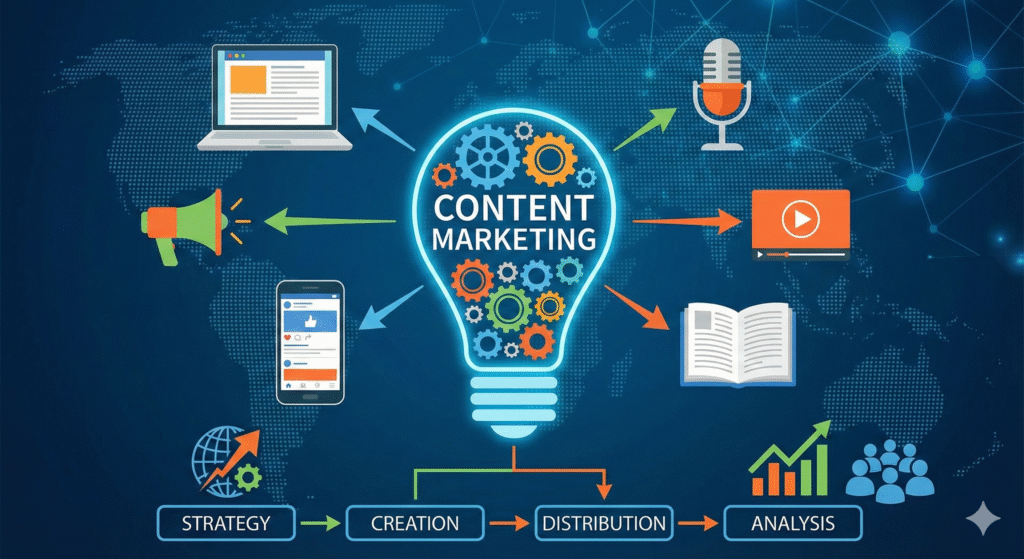
Content is still king, but the king is different. We are now living in a ‘vibe marketing’ world where authenticity outweighs high-budget production.
The Death of “Perfect”: The super-produced shiny commercial is being outperformed by ‘Lo-Fi’ content. A raw video taken on an iPhone in a warehouse feels more authentic than a $50,000 studio production.
The Power of Short-Form: TikTok, Reels, and YouTube Shorts have made the 9:16 vertical format the accepted standard. The “hook” must be in the first 1.5 seconds.
Serialized Storytelling: To fight against shrinking attention spans, a modern Beginner’s Guide to Digital Marketing must include “shows.” Instead of one-off ads, brands craft five-part series like “How to Scale Your Business.”
3. Social Media & Community
The “funnel” is being squeezed. That’s the way it worked: You saw an ad, went to a site and eventually bought the product. Now you can buy on social with checkout systems.
Shoppable Video: Streamlining the Beginner’s Guide to Digital Marketing Funnel:
Tap a product tag in a video to shop without leaving the app. It reduces “friction,” those moments when a consumer might have second thoughts as a web page is loading.
Influencer Partnerships 2.0: We’re beyond the “mega-celebrities.” This Beginner’s Guide to Digital Marketing Now, you might want to start with the micro-influencers (10k-50k followers) that have much more engagement and stronger trust.
4. The Data Privacy Revolution
In the second act of digital marketing, the biggest change is the death of the third-party cookie.
First-Party Data: Brands can no longer track users across the internet. They tap into the data users give themselves — which is why you get “10% off if you sign up to our newsletter.”
Zero-Party Data: That is even more valuable. Conscious data individuals actively provide information about their preferences (for example “I drink decaf coffee”).
Ethical Marketing: Privacy is a feature in 2026. Brands that are transparent about how they use data have a competitive advantage in the area of “Brand Trust.”
5. Artificial Intelligence: The Beginner’s Guide to Digital Marketing Co-Pilot
AI is now far more than just a text generator; it’s a full suite of tools.
Predictive Analytics: AI can tell which leads are more likely to buy in the next week, so you can get better use of your ad money.
Dynamic Creative Optimization (DCO): An AI will take one ad concept and turn it into hundreds of permutations — changing colors and headlines, seeking the right message — for different groups. AI Chatbots: Today’s AI chatbots can handle complicated customer service questions, process returns and even upsell products — all day and all night.
Technical Optimization: Using Semantic Triplets in a Beginner’s Guide to Digital Marketing
Today’s SEO is not only related to the entity Apple, but also to the distance between entities. AI models perceive data in terms of “triplets” such as [Brand Name] (Subject) [Offers] (Predicate) [Eco-friendly Logistics] (Object). In order to rank in GEO, AI needs to be able to establish these connections by reading your content and let your brand into its knowledge graph.
2. Conversational Intent Mapping
In strands of the Beginner’s Guide to Digital Marketing, we’re progressing towards moving away from “short-tail keywords” towards “conversational clusters.” Users are now interrogating AI agents with questions like “Where can I find a ceramic coating car detailing service near me?” To win at SEO in 2026, you need to answer long-form, natural language questions, and not just chase after the keyword “car detailing.”
3. Citational Authority in AI Responses
GEO is all about making “source.” When Gemini or ChatGPT respond to a query, they will often include citations. To become the cited source, your content has to contain unique data, original research or a strong definitive “take” that AI can recognize as the highest authority for that particular subject.
4. Schema Markup 2.0 (Linking Entities)
Whereas vanilla Schema made reviews easy to understand for Google, in 2026 “Advanced Schema” clarifies the “Who, What, and Where” of your business to AI. Once you use linked data to declare that your website is the official digital presence of a particular location or professional service, you reduce the risk of AI “hallucinating” facts about your brand.
5. Optimizing for “Answer Engine Optimization” (AEO)
A critical shift in this Beginner’s Guide to Digital Marketing is AEO. This involves structuring content in a Q&A format. By providing a concise summary at the top of your blog (the “Answer”) followed by detailed evidence, you increase the likelihood of being featured in the “Snippet” or AI summary box.
Why does it matter now?
The online world is more crowded than ever. People spend more than 7 hours per day on average on the Internet. For brands, digital advertising is the most efficient means of reaching these people. It costs just a fraction of traditional advertising and has a far higher Return on Investment (ROI)because you can advertise only to those who are most likely to purchase your product.
The Human Factor” and Employee Advocacy
As AI-written content increases on the web, humanity is a limited commodity. Any Beginner’s Guide to Digital Marketing today must highlight that customers want to meet the people behind the brand.
- EGC (Employee-Generated Content): When an engineer posts about a new feature on LinkedIn, it often carries 10x the weight of a company press release.
- Community Management: Digital marketing in 2026 is about “unscalable” gestures: personally responding to comments and fostering a community where customers talk to one another.
How do I start off
If you’re interested in learning about digital marketing, these three things are the best place to start:
Know Your Audience: Who is it? What platforms do they use?
Make your goals SMART: Don’t just have the goal of “getting more followers.” Have a target of “increasing traffic to the website by 20% in 3 months.”
Track and Test: Monitor what’s working with tools like Google Analytics, then try some new things to test.
1. The SEO Shift: Keywords to “Entities” and GEO
For twenty years, digital marketing through Search Engine Optimization (SEO) was all about keywords. ‘If you sold blue running shoes,’ you just repeated that phrase enough to get found. Now, enterprises are bringing Large Language Models (LLMs) to Search Engines (SEs) to interpret intent.
- Generative Engine Optimization (GEO): As AI Snippets are taking over the search results page designs, users find their answers without clicking on a link. GEO is the art of optimizing your content in a way that AI models quote you as a reference. This high “E-E-A-T” (Experience, Expertise, Authoritativeness, and Trustworthiness) is necessary.
- Search Everywhere Optimization: People don’t just search on Google. They now go to TikTok for reviews, Amazon for products, and ChatGPT for advice. Modern SEO means having a presence across all these “mini-search engines”
- Search Everywhere Optimization: People don’t just search on Google. They search on TikTok for reviews, Amazon for products, and ChatGPT for advice. Modern SEO means having a presence across all these “mini-search engines.”
2.The Content Renaissance: Short-Form, Serialized, and Human
In 2025, video isn’t part of the strategy: It is the strategy.
- The Power of Short-Form: TikTok, Reels, and YouTube Shorts have made the 9:16 vertical format the accepted standard. The “hook” must be in the first 1.5 seconds.
- Serialized Storytelling: To fight against shrinking attention spans in digital marketing, brands are developing “shows.” Instead of one-off ads, they craft five-part series such as “How to Scale Your Business” or “A Day in the Life of Our Founder.” This creates a “Netflix-style” loyalty as users anticipate the next episode.”
- The Death of “Perfect”: The super-produced shiny commercial is being outperformed by ‘Lo-Fi’ content. There’s something about a raw video taken on an iPhone in a warehouse that feels more authentic than a $50,000 studio production.
3.Social Commerce: Shop Without The Barrier
The “funnel” is being compressed. You used to see an ad, go to a site and eventually buy the product. Now, social media platforms have checkout systems.

- Shoppable video: Now you can tap a product tag in a video to buy without leaving the app. That reduces some of the “friction” — those moments when a consumer may have a change of heart as a web page loads.
- Influencer Partnerships 2.0: “We’ve gotten beyond ‘mega-celebrities’.” Brands are now turning to micro-influencers (10k-50k followers) who have far more engagement and stronger trust within niche categories such as sustainable fashion or indie gaming.
4.The Data Privacy Revolution
Digital marketing In the play behind the scenes with the biggest change is the third-party cookie’s end.
- First-party data: Brands aren’t able to follow users across the web anymore. They have to begin to look to “First-Party Data” — data users provide themselves. And that’s why we see so many brands saying “10% off if you sign up to our newsletter.” They’re not just making one sale; they are buying a direct line to you.
- Zero-Party Data: This is even more valuable. It’s data that individuals consciously share about their preferences (e.g. “I drink decaf coffee” or “I wear a size medium”).
- Ethical Marketing: Privacy Is A Feature In 2026. Brands that are transparent about how they use data have a competitive advantage in “Brand Trust,” according to the organization.
5.Artificial Intelligence: The Marketing Co-Pilot
AI is now much more than just a text generator; it’s a platform full of functionalities.
• Predictive Analytics: Consider the last 1,000 customers AI also can predict which leads are most likely to buy in the next week, so you can use your ad dollars a little better.
• Dynamic Creative Optimization (DCO): An AI will take a single ad idea and spin out hundreds of iterations — swapping colors, headlines and images — to find the right message for a 20-year-old student versus a 50-year-old executive.
• AI Chatbots: We are beyond the ’I don’t understand that’ bots. Today’s AI agents can manage intricate customer service inquiries, perform returns, and even upsell products around the clock.
6.“The Human Factor” and Employee Advocacy
As AI writing content increases on the web, humanity is somewhat a limited commodity.
Customers want to meet the people behind the brand –
- EGC (Employee-Generated Content): When an engineer posts about a new feature on LinkedIn, it often carries 10x the weight of a company press release.
- Community Management: Digital marketing 2026 is about “unscalable” gestures (personally responding to comments, holding small VIP webinars and fostering a community where customers talk to one another, not just to the brand).
The Road Ahead
Digital marketing is no more a department; it is the heartbeat of the business. To keep your edge, you have to be a “T-Shaped” marketer: have a generalist understanding of all of these fields, but specialize deeply in one (like AI automation or video storytelling). The end goal isn’t to just be “digital” — it’s to be human in a digital world